


You will not be allowed to compare more than 4 products at a time
View compareSuperfeet Run Support Medium Arch Insoles (Max Thickness)
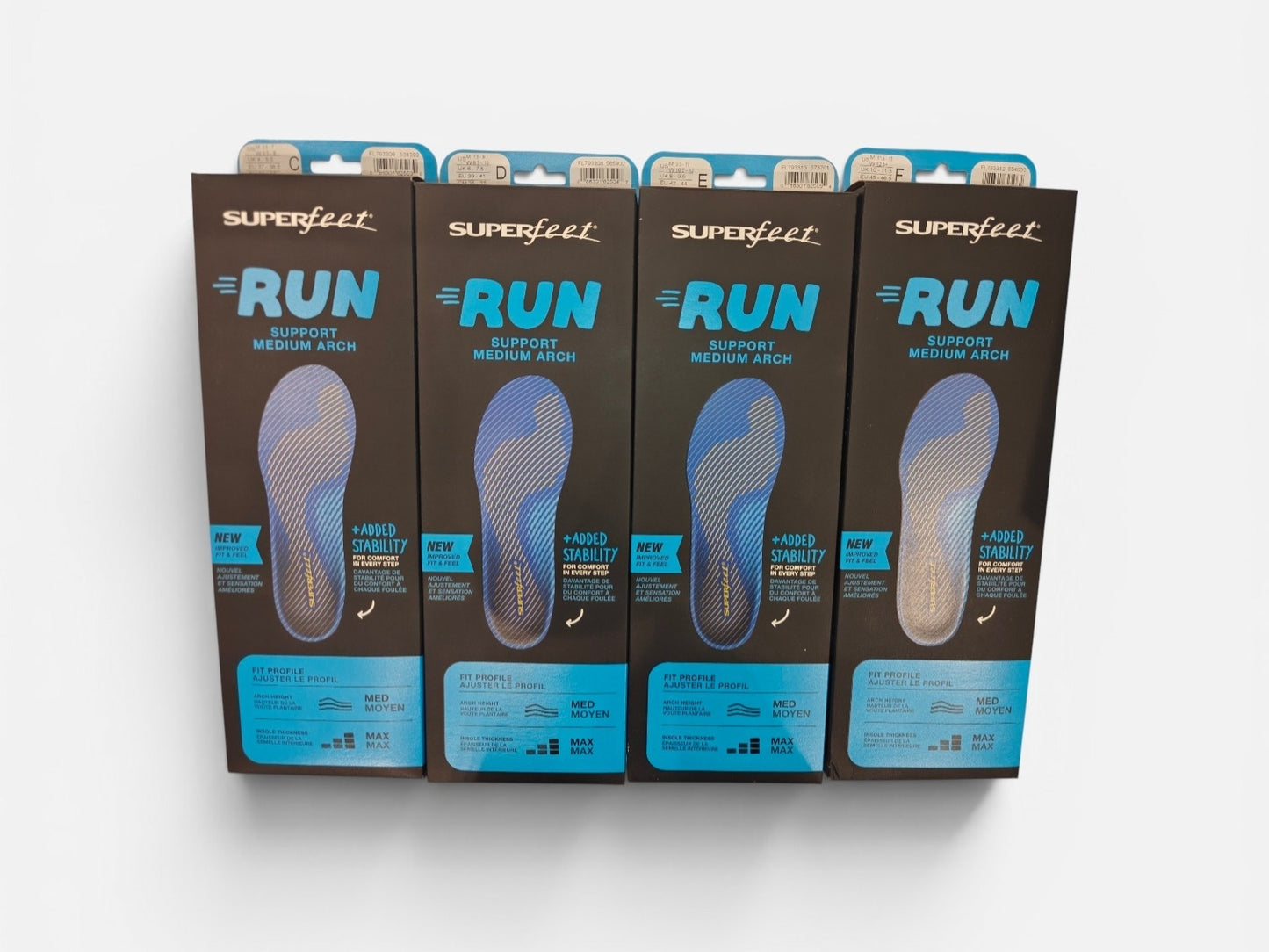
Superfeet Run Support Medium Arch Insoles (Max Thickness)
Regular price
$64.99 CAD
Sale price
$64.99 CAD
Regular price
Unit price
per
Shipping calculated at checkout.
Low stock

Description
Shipping Information
Mile 18: When Your Insoles Decide Your Marathon
You feel fine at mile 8 of your training run along the seawall. By mile 15, your arches start aching from the relentless pavement impact. By mile 18, you're limping — and your race is two weeks away. This pattern means your running insoles are not built for the distance you train. Superfeet Run Support Medium Arch with maximum thickness is engineered specifically for distance runners. Yaletown Medical Supplies stocks this insole for Vancouver runners training across the seawall and bridges.
The Three-Question Test
Answer these three questions to know if this insole fits your running situation:
Question 1: What's your typical weekly mileage?
- Under 15 km: lighter insoles work fine.
- 15-50 km per week: this insole is engineered for you.
- Over 50 km: pair this with stretching and rotation.
Question 2: What's your arch height?
- High arch: choose Superfeet GREEN or Run Support High Arch.
- Medium arch: this insole fits your foot anatomy.
- Low arch: choose Run Support Low Arch instead.
Question 3: Do you want cushion or correction?
- Pure rigid correction: choose Superfeet ORANGE.
- Balance of support and cushion: this insole was built for you.
- Pure cushion only: choose All-Purpose Memory Foam.
If all three answers match, this is your running insole for the next 6-12 months.
Built for the Long Run
Distance runners face unique foot challenges that sprinters and casual walkers never encounter.
What happens to your feet during long runs:
- The plantar fascia tissue absorbs 3-5 times body weight per stride.
- Each foot strikes the ground 80-100 times per minute during running cadence.
- A 30-minute run delivers 5,000+ impacts to each foot during training.
- Repeated impact causes micro-trauma that accumulates over training weeks.
- Most running injuries develop from improper foot mechanics during distance training.
What Run Support Medium Arch does about it:
- Cushions the heel strike with maximum thickness foam under the heel.
- Supports the medium arch through the stance phase of each stride.
- Maintains structure through long runs without compressing prematurely.
- Distributes impact across the foot rather than concentrating at pressure points.
- Reduces the cumulative training load that causes overuse running injuries.
The Medium Arch + Max Thickness Combination
This specific configuration suits a particular runner profile — and it's the most common one.
Medium arch runners include:
- Most adult runners with naturally average arch height.
- Runners between high arches (cavus) and flat feet (planus) profiles.
- Athletes who don't show pronounced inward or outward foot rolling.
- Runners whose footprints show clear arch curve but full ball contact.
Maximum thickness for distance includes:
- Half-marathon training building from 5km base mileage upward.
- Marathon training programs reaching 30-40km long runs near peak.
- Ultra-marathon training in BC trails and mountain running scenarios.
- Daily 10km commute runs across Vancouver's downtown core regularly.
- Multiple weekly runs accumulating over 25km of training volume.
The combination balances support and cushion for runners covering real training mileage.
A Mile-by-Mile Breakdown
Here's what happens during a typical long run with proper running insoles versus poor ones:
Miles 1-3 (Warm-up phase):
- Insoles barely matter at this distance — any reasonable cushion feels fine.
- Most runners can't distinguish between insoles in this first 5km segment.
Miles 4-7 (Comfort phase):
- Cheap insoles start showing their limits during this midrange phase.
- Foot fatigue begins for runners using flat insoles or poor support.
- Superfeet Run Support maintains comfortable foot positioning throughout.
Miles 8-13 (Half-marathon territory):
- Most running insoles compress significantly by this mileage range.
- Generic insoles bottom out, transferring all impact to your foot tissues.
- Superfeet Run Support Max Thickness still provides full cushion at this point.
Miles 14-20 (Marathon training territory):
- Foot fatigue separates good insoles from great ones during these miles.
- Inferior insoles cause arch pain, plantar discomfort, and altered running form.
- Run Support Medium Arch maintains structure when most other options have failed.
Miles 20+ (Race performance territory):
- Insole performance directly impacts race finishing strength.
- Cushion and support determine whether you negative-split or struggle home.
Run Support vs ORANGE: Which for Runners?
Both Superfeet lines suit serious athletes — but they solve different running problems:
Choose Run Support Medium Arch (this product) when:
- Running is your primary athletic activity.
- You log 15-50 km weekly during training cycles.
- You want balanced support and cushion designed specifically for running.
- You have a medium arch profile.
- You prefer maximum thickness for distance training comfort.
- You train for races up to and including marathons.
Choose Superfeet ORANGE (High Impact) when:
- You have plantar fasciitis as a specific clinical diagnosis.
- You play multiple sports including running, hiking, and court sports.
- You want maximum biomechanical correction with rigid structure.
- You have overpronation that affects your running form significantly.
- You hike Vancouver trails AND run road races equally.
Vancouver Runner's Routes — Where This Insole Earns Its Cost
This insole tested itself across Vancouver's most popular running routes:
- Seawall (Stanley Park to False Creek) — 22 km of continuous pavement impact.
- BMO Vancouver Marathon course — through downtown, Kits, and University Endowment Lands.
- Sun Run 10K route — Burrard Bridge, Stanley Park, Cambie Street downtown.
- Lions Gate Bridge hill workouts — steep climbs and descents stress feet differently.
- North Shore trail running — Capilano River, Lynn Canyon, and Mt Seymour routes.
- UBC Endowment Lands trails — soft trail surfaces with technical roots and rocks.
- Pacific Spirit Park — rolling singletrack popular with serious local runners.
Vancouver's mix of pavement and trail running benefits from the Max Thickness cushioning option.
Training Phase Considerations
Your insole needs shift across your annual training cycle:
Base Phase (Off-season, low mileage):
- Lower mileage allows older insoles to last through this phase comfortably.
- This is when most runners delay buying new insoles unnecessarily.
Build Phase (Mileage increasing):
- New insoles installed during this phase break in before peak training arrives.
- The 4-6 week adaptation period happens before high mileage starts demanding peak support.
Peak Phase (Maximum mileage and intensity):
- Insole condition matters most during this phase of training cycles.
- Failing insoles cause cascading injuries during the highest-stress weeks.
Taper Phase (Reducing volume before race):
- Insole performance during peak phase determines race day foot condition.
- This is NOT the time to buy new insoles — stick with broken-in pairs.
Race Day:
- Wear the same insole-shoe combination that completed your longest training run.
- Never debut new insoles on race day — recipe for race-ruining foot problems.
Sizing Chart — Superfeet Run Support
Use this official Superfeet size chart to find your correct size:
| Size | Men's | Women's | Juniors | UK | Euro |
|---|---|---|---|---|---|
| J | — | — | 11.5-13 | 11-12.5 | 29-31 |
| A | — | — | 13.5-2 | 13-1.5 | 32-33.5 |
| B | — | 4.5-6 | 2.5-4 | 2-3.5 | 34-36 |
| C | 5.5-7 | 6.5-8 | — | 4-5.5 | 37-38.5 |
| D | 7.5-9 | 8.5-10 | — | 6-7.5 | 39-41 |
| E | 9.5-11 | 10.5-12 | — | 8-9.5 | 42-44 |
| F | 11.5-13 | 12+ | — | 10-11.5 | 45-46.5 |
| G | 13.5-15 | — | — | 12-13.5 | 47-49 |
| H | 15.5-17 | — | — | 14-15.5 | 50-52 |
Sizing tips:
- Use your running shoe size specifically — not your everyday casual shoe size.
- Most runners size up half a size in running shoes for swelling tolerance.
- Trim down if needed using your running shoe's original insole as a template.
- Bring your running shoes to Yaletown for in-store sizing during the visit.
Pronation and Your Running Form
Foot pronation affects every step you take — and it influences insole choice directly:
Neutral pronation:
- Foot rolls slightly inward during ground contact.
- This is the most common foot type among adult runners.
- Run Support Medium Arch fits neutral pronators very well.
Overpronation:
- Foot rolls inward excessively during ground contact.
- Often associated with low arches and flat feet.
- Run Support Medium Arch helps mild overpronation cases.
- Severe overpronation may need Run Support Low Arch or Superfeet ORANGE instead.
Underpronation (supination):
- Foot rolls outward or stays neutral during ground contact.
- Often associated with high arches.
- Run Support High Arch fits this pattern better than Medium.
A specialty running store or podiatrist can confirm your pronation pattern accurately.
Lifespan Tracking by Training Volume
Run Support insoles last differently depending on your weekly training mileage:
| Weekly Mileage | Expected Insole Life |
|---|---|
| Under 15 km | 12-18 months |
| 15-30 km | 8-12 months |
| 30-50 km | 6-8 months |
| Over 50 km | 4-6 months |
Track replacement using a simple rule:
- Mark the purchase date on your running journal or calendar app.
- Replace at 800-1000 km of running on the insole (rough rule of thumb).
- Inspect monthly for compression in the heel and forefoot areas.
- Replace immediately if you feel foot pain returning despite same training pattern.
What Yaletown Stocks for Vancouver Runners
Yaletown Medical Supplies stocks the complete Superfeet Run Support line:
- Run Support Medium Arch (Max Thickness) — this product for distance training.
- Run Support Low Arch — for flat-footed runners with overpronation patterns.
- Run Support High Arch — for high-arched runners with underpronation patterns.
- Superfeet ORANGE — for runners who also need plantar fasciitis support.
- Superfeet GREEN — for very high-arched runners wanting maximum rigidity.
- Running socks (Sigvaris, CEP) — compression for recovery and DVT prevention.
Our trained staff fits each runner during in-store visits at no extra charge.
Common Questions
Will BC extended health insurance cover Run Support insoles? Most plans cover prescription orthotics — but off-the-shelf insoles like Superfeet usually do not. Yaletown provides itemized receipts for any insurance reimbursement attempts you choose.
When should I install new insoles before a marathon? Install new Run Support insoles 6-8 weeks before race day for proper break-in. Never wear new insoles on race day — they need adaptation time before competition demands.
Can I use these for trail running? Yes — Run Support Medium Arch handles trail running with proper trail shoes. For technical terrain, you may prefer ORANGE for the additional lateral stability.
Will these help my IT band pain while running? IT band pain often relates to foot mechanics — improved insoles can reduce contributing factors. Consult a sports physician for complete IT band syndrome treatment beyond insole changes.
How do these compare to custom orthotics for runners? Custom orthotics cost $400-$800 in BC — Run Support delivers 80% of the benefit cheaper. Try Run Support first before investing in expensive custom solutions for most cases.
Can I use these in cycling or triathlon training? Cycling shoes have different requirements — Run Support is engineered specifically for running impact. For triathlons, install Run Support in your running shoes only, not your cycling shoes.
Do these come in different cushion firmness? This specific model uses Max Thickness — the most cushioned Run Support option. Lower thickness options exist for runners who prefer firmer foot feel during runs.
Will these affect my running form negatively? No — Run Support is engineered to support natural running biomechanics during distance training. Most runners notice improved comfort without significant form changes after the break-in period.
How long is the break-in period for running insoles? Plan 2-3 weeks of gradual increase before using these on long training runs. Start with shorter runs and build mileage as your feet adapt to the new support.
Can I machine wash these running insoles? No — hand wash with mild soap and air dry completely between uses. Machine washing damages the structure and reduces effective insole life dramatically.
Visit Yaletown for Runner-Specific Fitting Today
Distance running rewards preparation — and proper insoles are part of that preparation. Superfeet Run Support Medium Arch with maximum thickness was built for Vancouver runners. Visit Yaletown Medical Supplies for in-store sizing and runner-specific fitting today. Call 236-466-2141 or visit 1255 Pacific Blvd, Vancouver, BC for expert insole guidance.
We take great care to ensure that your order reaches you safely and promptly. All orders are processed and dispatched within 1-3 business days, depending on product availability. We work with reliable shipping partners to ensure fast and secure delivery.
Once your order has been shipped, you will receive a tracking number to monitor the progress of your shipment. Delivery times may vary depending on your location, typically ranging from 3 to 9 business days.
Please note that shipping will only be processed once payment has been fully completed. Orders will not be shipped until the payment is confirmed.
If you have any questions, feel free to contact our customer support team. We are happy to assist you.
Thank you for choosing us. We are committed to delivering your order promptly and ensuring a seamless shopping experience.