

You will not be allowed to compare more than 4 products at a time
View compareStethoscope Dual-Head Pediatric MDS9557
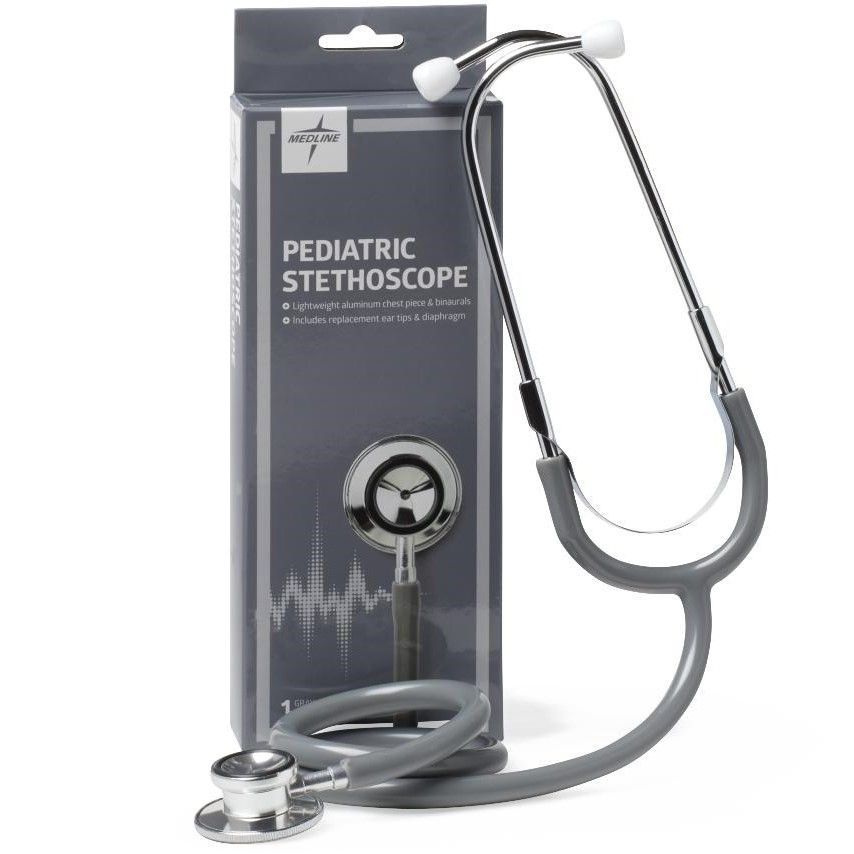
Stethoscope Dual-Head Pediatric MDS9557
Regular price
$19.90 CAD
Sale price
$19.90 CAD
Regular price
Unit price
per
Shipping calculated at checkout.
Description
Shipping Information
Why Pediatric Patients Need Pediatric Stethoscopes
Adult stethoscopes don't fit children's smaller chests, narrow rib spaces, and faster breathing patterns.
Pediatric stethoscopes use smaller chest pieces designed specifically for assessing children's vital signs.
The Medline MDS9557 dual-head pediatric stethoscope serves healthcare professionals working with kids.
Pediatric nurses, family physicians, EMTs, and medical students all rely on properly sized equipment.
Yaletown Medical Supplies stocks the MDS9557 for Vancouver healthcare professionals and nursing students.
This guide explains the dual-head design, who uses it, and proper technique for accurate auscultation.
The Dual-Head Design Explained
The Diaphragm (Flat Side):
- Larger flat surface with a thin membrane stretched across the chest piece.
- Captures high-frequency sounds (200-1000 Hz typically).
- Best for: normal breath sounds, normal heart sounds, abnormal lung sounds.
- Press firmly against the patient's skin during use.
The Bell (Cup-Shaped Side):
- Smaller cup-shaped opening without a membrane covering.
- Captures low-frequency sounds (20-200 Hz typically).
- Best for: heart murmurs, bowel sounds, vascular sounds, S3 and S4 heart sounds.
- Place lightly against the skin — too much pressure converts it to a diaphragm.
The Switching Mechanism:
- Rotate the chest piece to direct sound through either the diaphragm or bell.
- A small indicator shows which side is currently active.
- This allows quick switching during a single patient examination.
What's Different About Pediatric Stethoscopes
Anatomical differences in children:
- Smaller chest size — adult chest pieces cover too much area.
- Narrower rib spaces — pediatric chest pieces fit between ribs cleanly.
- Thinner chest walls — sounds transmit more clearly through children's tissues.
- Faster heart rates — children's normal heart rates run 60-160 bpm depending on age.
- Faster respiratory rates — children breathe 20-40 times per minute normally.
- Higher-pitched sounds — pediatric heart sounds run at slightly higher frequencies.
Design adaptations:
- Smaller diaphragm diameter — fits intercostal spaces in children's chests.
- Smaller bell — concentrates low-frequency sounds from smaller surface areas.
- Lighter tubing — easier handling during pediatric examinations.
Who Uses the Medline MDS9557
Pediatricians and Family Physicians
- Daily pediatric examinations in family practice and pediatric clinics.
- Well-baby visits, school physicals, and acute illness assessments.
Pediatric Nurses
- Hospital pediatric wards including BC Children's Hospital.
- Emergency department pediatric assessments.
- Pediatric ICU and neonatal intensive care units.
Medical and Nursing Students
- UBC medical students rotating through pediatric clinical placements.
- BCIT and other BC nursing programs with pediatric clinical rotations.
Emergency Medical Services (EMS)
- BC Ambulance Service paramedics assessing pediatric patients.
School and Daycare Health Staff
- School nurses serving Vancouver elementary and middle schools.
Veterinary Professionals
- Small animal veterinarians use pediatric stethoscopes for cats and small dogs.
What Each Side Listens For
Diaphragm uses (high-frequency sounds):
- Normal lung sounds — vesicular, bronchial, bronchovesicular.
- Abnormal lung sounds — wheezes, crackles, rhonchi, stridor.
- S1 and S2 heart sounds — normal heartbeat sounds.
- Heart valve sounds — clicks, snaps, mechanical valve sounds.
- Pleural friction rubs — pleural inflammation sounds in pneumonia cases.
Bell uses (low-frequency sounds):
- S3 heart sound — suggesting heart failure or fluid overload.
- S4 heart sound — suggesting stiff ventricle conditions.
- Heart murmurs — abnormal blood flow sounds across heart valves.
- Bowel sounds — intestinal motility sounds during abdominal assessment.
- Bruits — abnormal blood flow sounds in arteries.
Technical Specifications
| Specification | Detail |
|---|---|
| Brand | Medline |
| Model | MDS9557 |
| Type | Dual-head pediatric stethoscope |
| Diaphragm | Pediatric size |
| Bell | Standard configuration |
| Tubing | Medical-grade flexible tubing |
| Earpieces | Soft cushioned ear tips |
| Binaural design | Anatomically angled |
| Length | Standard clinical length |
| Weight | Lightweight for daily wear |
How to Use the MDS9557 Correctly
Step 1: Insert the Earpieces Correctly
Earpieces angle forward — pointing toward your nose, not directly into your ears.
Step 2: Position the Patient Properly
Sit older children in a chair or on the parent's lap.
Infants and toddlers may need to be held during the examination.
Step 3: Warm the Chest Piece First
Cold chest pieces startle children and make them cry.
Warm the metal between your palms for 10-15 seconds.
Step 4: Choose Diaphragm or Bell
Start with the diaphragm for general lung and heart assessment.
Switch to the bell when investigating specific low-frequency findings.
Step 5: Apply Appropriate Pressure
Diaphragm — firm pressure for full skin contact.
Bell — light pressure to maintain bell function.
Step 6: Listen in Multiple Locations
Move the chest piece methodically across multiple chest locations.
Compare sounds between corresponding spots on left and right sides.
Care and Maintenance
Daily care:
- Clean the chest piece with alcohol wipes between every patient.
- Wipe the tubing with disinfectant wipes at start and end of shift.
- Inspect the earpieces for accumulated debris.
Weekly care:
- Replace dirty ear tips when discolored or contaminated.
- Check tubing flexibility — replace if stiff or cracked.
- Tighten loose connections between headset and tubing.
Infection control:
- Never share the stethoscope without disinfection.
- Avoid extreme temperatures which damage rubber tubing.
- Store in a clean dry location when not in use.
Pediatric vs Adult Stethoscope
| Feature | Pediatric (MDS9557) | Adult Stethoscope |
|---|---|---|
| Chest piece size | Smaller diameter | Larger diameter |
| Optimal patient age | Newborn to ~12 years | Adolescents and adults |
| Acoustic frequency focus | Higher pitch range | Standard range |
| Intercostal fit | Fits narrow rib spaces | Spans wider rib spaces |
| Weight | Lighter | Standard |
| Best for | Pediatric assessments | Adult assessments |
| Veterinary use | Cats, small dogs | Large dogs, livestock |
What Yaletown Stocks for Healthcare Professionals
- Medline MDS9557 (this product)
- Adult stethoscopes — single and dual-head
- Cardiology stethoscopes — premium acoustic instruments
- Disposable stethoscopes — for infection control units
- Blood pressure cuffs — adult and pediatric
- Otoscopes and ophthalmoscopes — for complete examination kits
- Penlights and reflex hammers — basic neurological exam tools
- Stethoscope accessories — ear tips, diaphragm membranes
Common Questions
Will BC extended health insurance cover this stethoscope?
Healthcare professional instruments are typically professional expenses, not personal health expenses.
Many professionals deduct stethoscope costs as work-related professional expenses.
Can I use this on adult patients in a pinch?
Yes — but the smaller chest piece is less efficient for adult assessments.
How long does a pediatric stethoscope last?
Quality stethoscopes last 5-10 years with proper care.
Can nursing students use this stethoscope?
Yes — many BC nursing programs require students to purchase their own.
Is this stethoscope suitable for infants and newborns?
The pediatric size works for infants — neonatal patients may need a specialized neonatal stethoscope.
How do I know if the diaphragm is engaged correctly?
Look at the chest piece — most models have an indicator showing the active side.
Can I replace just the ear tips?
Yes — replacement ear tips are available for the MDS9557 in multiple sizes.
What if the stethoscope is dropped onto a hard floor?
Inspect the chest piece, tubing, and earpieces immediately for visible damage.
Can veterinarians use this stethoscope on animals?
Yes — pediatric stethoscopes work well on cats, small dogs, and small mammals.
We take great care to ensure that your order reaches you safely and promptly. All orders are processed and dispatched within 1-3 business days, depending on product availability. We work with reliable shipping partners to ensure fast and secure delivery.
Once your order has been shipped, you will receive a tracking number to monitor the progress of your shipment. Delivery times may vary depending on your location, typically ranging from 3 to 9 business days.
Please note that shipping will only be processed once payment has been fully completed. Orders will not be shipped until the payment is confirmed.
If you have any questions, feel free to contact our customer support team. We are happy to assist you.
Thank you for choosing us. We are committed to delivering your order promptly and ensuring a seamless shopping experience.